

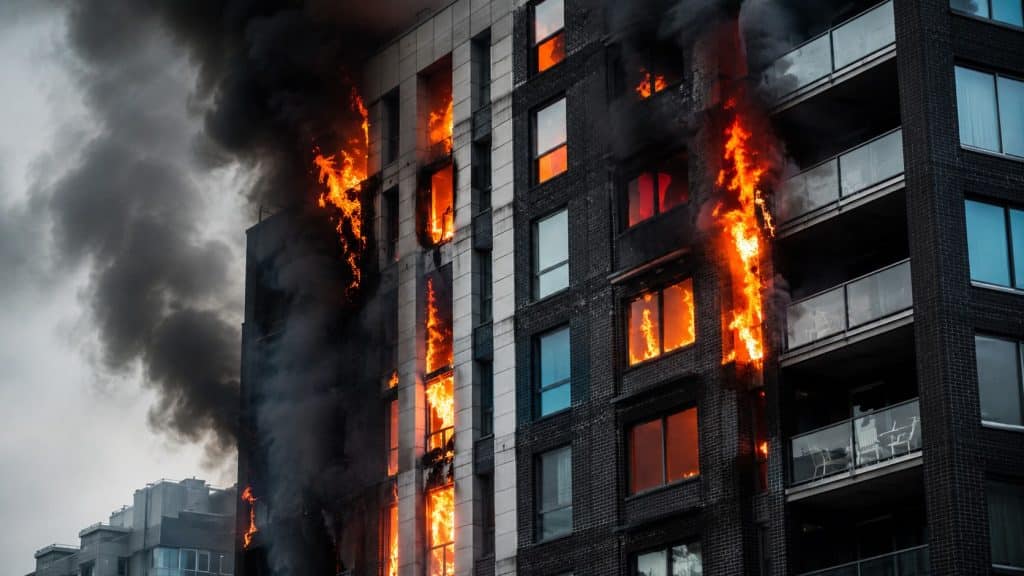
When people think about fire protection in buildings, they often picture smoke alarms, fire extinguishers, sprinklers, or fire doors. While these systems all play important roles, some of the most effective fire safety measures are hidden completely from view.
One such example is the cavity barrier.
Installed within concealed spaces such as walls, floors, ceilings, and roof voids, cavity barriers are designed to stop fire and smoke from spreading through areas that most building occupants never see. Although they may be largely invisible once construction is complete, cavity barriers play a critical role in modern fire safety and are an essential part of many passive fire protection strategies.
Without them, fires could spread through buildings far more quickly and with far less resistance.
What Is a Cavity Barrier?
A cavity barrier is a fire-resistant product installed within concealed voids to restrict the movement of fire and smoke.
Modern buildings often contain numerous cavities and hidden spaces. These may exist behind external cladding systems, within cavity walls, above suspended ceilings, beneath raised floors, or inside roof structures.
While these spaces serve important construction purposes, they can also create pathways that allow fire to travel unnoticed throughout a building.
Cavity barriers are designed to interrupt these pathways, helping to divide concealed spaces into smaller sections and limiting the distance that fire and smoke can travel.
Why Modern Buildings Contain So Many Cavities
Building design has evolved significantly over the years.
Modern construction methods frequently use cavity walls, service voids, suspended ceilings, and lightweight partition systems. These features improve thermal performance, allow services to be installed more easily, and provide greater flexibility during construction.
However, the more concealed spaces a building contains, the greater the potential for fire to spread unseen.
A fire that enters a cavity may move through hidden areas long before visible flames appear elsewhere in the building.
This is why cavity barriers have become such an important part of modern fire protection.
Hidden Spaces Can Allow Rapid Fire Spread
One of the biggest challenges with concealed voids is that they can act like unseen routes for fire and smoke.
A fire may begin in one room, enter a ceiling void, wall cavity, or roof space, and then spread into completely different areas of the building without occupants realising it.
In some situations, fire can travel considerable distances through these hidden spaces before becoming visible again.
By the time flames emerge elsewhere, the fire may already be far larger and more difficult to control.
Cavity barriers help reduce this risk by preventing concealed spaces from becoming uninterrupted channels for fire spread.
How Cavity Barriers Work
The principle behind cavity barriers is relatively simple.
Rather than allowing a concealed void to run continuously throughout a building, barriers are installed at strategic locations to subdivide the space.
These barriers create fire-resistant breaks that restrict the passage of flames, hot gases, and smoke.
Some cavity barriers are designed to remain fixed at all times, while others contain intumescent materials that expand when exposed to heat. As temperatures rise, the material expands to seal the cavity and help prevent fire from moving further.
This containment helps support the wider fire safety strategy of the building.
Cavity Barriers and Compartmentation
Cavity barriers are often described as part of a building’s compartmentation system.
Compartmentation involves dividing a structure into separate fire-resistant sections to contain fire within a limited area for a specified period of time.
Most people associate compartmentation with fire-resistant walls, floors, and fire doors. However, these visible barriers can be undermined if concealed cavities allow fire to bypass them.
Cavity barriers help maintain the integrity of compartmentation by ensuring that hidden spaces do not become alternative routes around fire-resistant construction.
In many cases, they provide the missing link that allows a compartmentation strategy to function effectively.
Where Are Cavity Barriers Installed?
Cavity barriers can be found in a variety of locations throughout modern buildings.
Common installation areas include:
- Cavity walls.
- Roof voids and loft spaces.
- Suspended ceiling voids.
- Raised access floors.
- External cladding systems.
- Service risers and concealed service routes.
- Junctions between different building elements.
The exact placement depends on the building design and the applicable fire safety requirements.
Although occupants rarely see them, cavity barriers are often present throughout the structure.
Why Installation Quality Matters
Like many fire protection measures, cavity barriers are only effective if they are correctly installed.
Poor fitting, gaps, missing sections, or damage during construction can significantly reduce performance. Even small defects may create openings through which fire and smoke can pass.
Because cavity barriers are usually concealed after installation, defects can remain unnoticed unless proper inspection and quality control procedures are followed.
This highlights the importance of competent installation and thorough fire safety inspections during construction and refurbishment projects.
The Importance of Cavity Barriers in Refurbishments
Refurbishment and maintenance work can sometimes affect existing fire protection measures.
When new services are installed, walls are altered, or building layouts are changed, cavity barriers may be disturbed or removed unintentionally.
If these barriers are not reinstated correctly, previously protected voids may become vulnerable to fire spread.
For this reason, cavity barriers should always be considered whenever significant building work takes place.
Protecting concealed fire safety systems is just as important as maintaining visible fire protection features.
Helping Firefighters Contain Fires
Cavity barriers do not just protect occupants and property; they also assist firefighters.
When fire spread is restricted, emergency services can focus on a smaller area and are less likely to encounter unexpected fire development elsewhere in the building.
Without cavity barriers, hidden fire spread can make firefighting operations more difficult and unpredictable.
Containing fire within defined areas improves the chances of bringing the incident under control before extensive damage occurs.
Buying Valuable Time
Like many forms of passive fire protection, cavity barriers are fundamentally about buying time.
Time for occupants to detect the fire.
Time to evacuate safely.
Time for emergency services to arrive.
Time to prevent a localised incident from becoming a major building-wide fire.
Every minute that fire spread is delayed can have a significant impact on the outcome of an incident.
Although they are rarely seen, cavity barriers contribute directly to this objective.
Final Thoughts
Cavity barriers are one of the most important yet least visible elements of modern fire protection.
Installed within concealed spaces throughout a building, they help prevent fire and smoke from spreading through hidden routes that could otherwise bypass walls, floors, and other fire-resistant construction.
By supporting compartmentation, protecting concealed voids, and limiting fire spread, cavity barriers play a vital role in keeping occupants safe and reducing property damage during a fire.
Most building users will never see a cavity barrier, but their contribution to fire safety is significant. In many cases, these hidden systems are quietly working behind the scenes to ensure that a small fire remains exactly that, a small fire.
For expert advice on fire protection and prevention measures, contact Martyn Young Fireproofing Consultancy on 07585 896648