

When plastic pipes pass through fire-resistant walls or floors, they can create a serious weakness in a building’s compartmentation.
During a fire, many plastic pipes soften, melt or burn away. If nothing is in place to deal with that change, the opening left behind can provide a route for flames, smoke and hot gases to pass from one compartment to another.
Two of the most common passive fire protection products used to protect these penetrations are fire collars and fire wraps.
They are often mentioned together, and they perform a similar basic function, but they are not the same product and they are not always interchangeable.
Understanding the difference is important because the correct choice depends on the pipe, the wall or floor construction, the size of the penetration and the tested fire-stopping system being used.
What Is a Fire Collar?
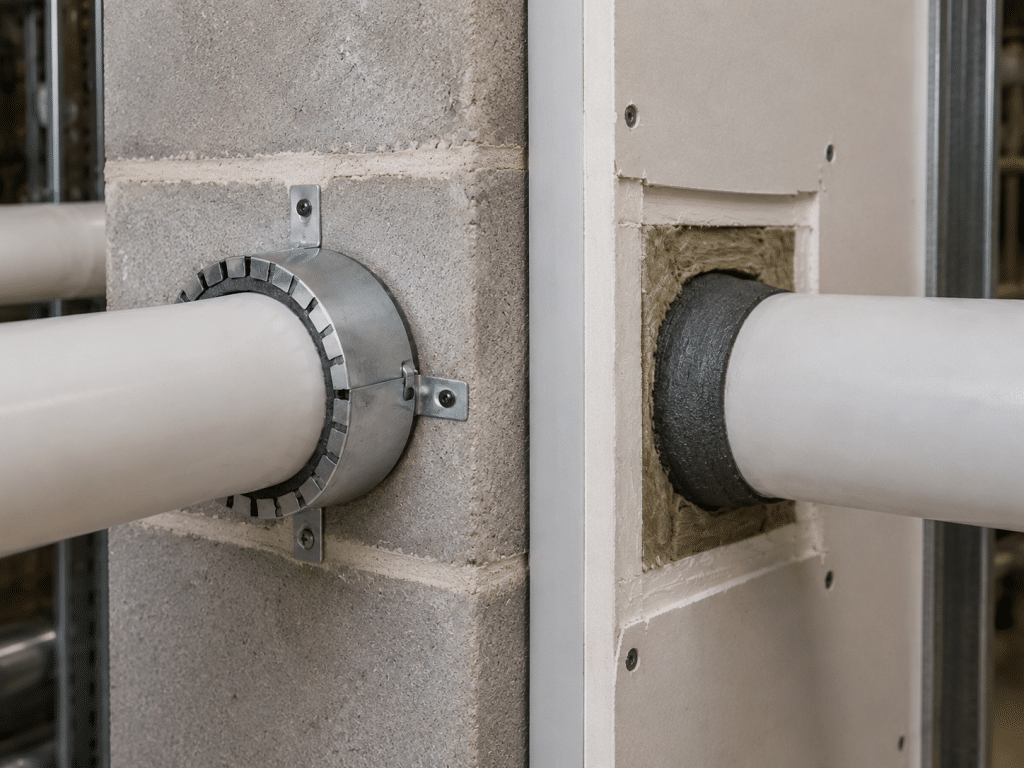
A fire collar is a rigid or semi-rigid device fitted around a combustible pipe where it passes through a fire-resistant wall or floor.
It usually consists of a metal outer casing containing an intumescent material.
Under normal conditions, the collar sits tightly around the pipe and does very little. During a fire, however, the intumescent material reacts to heat and expands.
As the plastic pipe softens or disappears, the expanding material helps close the opening left behind.
This helps maintain the integrity of the compartment boundary for the period covered by the tested system.
Fire collars are commonly surface-mounted to the face of a wall or floor, although the exact installation depends on the approved system.
What Is a Fire Wrap?
A fire wrap performs a very similar function but usually has a different form.
Instead of a rigid metal casing, a fire wrap is typically a strip or band of intumescent material that is wrapped around the pipe.
Depending on the system, it may be:
- installed within the wall or floor,
- recessed into the penetration,
- incorporated into another fire-stopping product,
- or positioned around the pipe before the surrounding opening is sealed.
When exposed to heat, the wrap expands in the same general way as a collar, helping close the void created as the combustible pipe degrades.
The key difference is that a wrap is usually more concealed and flexible, whereas a collar is generally a more visible, mechanically fixed component.
So What Is the Main Difference?
The simplest way to think about it is this:
A fire collar is a contained, mechanically fixed intumescent device. A fire wrap is an intumescent strip or band installed around the pipe, often within the penetration.
Both are designed to deal with combustible services, particularly plastic pipes, but their installation methods and tested applications differ.
That means you should never choose between them purely based on appearance, convenience or cost.
The correct solution is the one that matches the relevant tested or assessed system.
Why Plastic Pipes Need Special Protection
Plastic pipes behave very differently from metal pipes during a fire.
A metal pipe may remain physically present, although it can conduct heat through a compartment boundary.
A plastic pipe can soften, collapse and eventually disappear.
That creates a problem.
Imagine a 110mm plastic soil pipe passing through a fire-resistant wall. If the pipe melts away, the wall is no longer solid at that point. A large opening may be left where the pipe used to be.
That opening could allow fire and smoke to pass through much earlier than intended.
Fire collars and wraps are designed specifically to react to this change.
How Intumescent Material Works
Both collars and wraps rely on intumescent technology.
Intumescent materials expand significantly when exposed to high temperatures.
As the pipe begins to soften, the material expands inward and fills the space.
The pressure created by the expanding material can help crush the remaining plastic and close the penetration.
This reaction helps preserve the fire performance of the wall or floor.
The product is therefore not simply acting as a seal around the outside of the pipe. It is designed to react dynamically as fire conditions develop.
When Might a Fire Collar Be Used?
Fire collars are often used where a clear, surface-mounted solution is required.
Typical applications may include:
- plastic pipes passing through masonry walls,
- pipes passing through concrete floors,
- service penetrations where mechanical fixing is straightforward,
- and locations where the fire-stopping system is designed around a visible collar.
Because collars are usually fixed to the substrate, they can also be easier to inspect after installation.
An inspector can often see whether the collar is present and whether it has been mechanically fixed.
However, that does not automatically prove that the installation is correct. The pipe size, fixing method, substrate and collar type must still match the approved system.
When Might a Fire Wrap Be Used?
Fire wraps are often useful where a more concealed installation is preferred or where the tested system requires the intumescent material to sit within the penetration.
They may be used:
- inside walls,
- within floors,
- behind boards,
- within compound or mortar seals,
- or where the design makes a surface-mounted collar less practical.
Because wraps are often hidden once installed, documentation and photographic evidence can be particularly important.
After the opening has been sealed, it may be difficult to confirm visually that the correct wrap was installed in the correct position.
Are Fire Collars and Fire Wraps Interchangeable?
Not necessarily.
This is one of the most important points.
Although they perform a similar role, you cannot assume that a collar can always be replaced with a wrap or vice versa.
Fire-stopping systems are tested as complete configurations.
That may include:
- pipe material,
- pipe diameter,
- wall or floor type,
- wall or floor thickness,
- penetration size,
- collar or wrap position,
- number of wrap layers,
- fixing method,
- and any additional sealing materials.
Changing one of these elements may mean the installation no longer matches the tested system.
A product that is suitable in one situation may be completely inappropriate in another.
Does Pipe Size Matter?
Yes. The diameter of the pipe is often a critical part of the tested configuration.
A collar designed for a smaller pipe cannot simply be stretched or adapted for a larger one.
Likewise, fire wraps may require a specific number of layers depending on the pipe diameter and material.
The thickness of the pipe wall can also matter.
Different plastic types can behave differently during a fire, so the same fire-stopping product may not be approved for every pipe material.
That is why correct product selection is essential.
What About Wall and Floor Construction?
The supporting construction matters just as much as the pipe.
A fire collar tested on a rigid masonry wall may not automatically be suitable for a lightweight plasterboard partition.
Similarly, an installation through a floor is not the same as an installation through a wall.
Orientation, substrate strength and fixing method all influence performance.
This is another reason why passive fire protection should always be treated as a system rather than a collection of individual products.
Which One Is Better?
Neither is universally better.
A collar may be the better solution in one application, while a wrap may be more appropriate in another.
The correct choice depends on:
- the service,
- the opening,
- the substrate,
- the required fire resistance,
- the installation location,
- and the available tested evidence.
The best product is simply the one that has been correctly specified for the actual situation.
Why Installation Quality Matters
Even the correct product can fail to perform as intended if it is installed incorrectly.
With collars, common issues may include:
- missing fixings,
- incorrect fixing types,
- loose installation,
- unsuitable substrates,
- or gaps around the penetration.
With wraps, problems may include:
- too few layers,
- incorrect positioning,
- poor overlap,
- or the wrap being installed at the wrong depth.
Because wraps are often concealed, these errors may be harder to detect once the work is complete.
Good quality control is therefore essential.
Why Documentation Matters
For passive fire protection, installation records are extremely valuable.
Photographs taken before the penetration is closed up can show:
- the product used,
- the number of wrap layers,
- the position of the system,
- and the service being protected.
Product references and system details can then be linked to the installation.
This makes future inspection and maintenance much easier.
Without records, an inspector may be left trying to determine what has been installed after most of the important components have been hidden.
Can You Tell the Difference Just by Looking?
Sometimes. A fire collar is usually obvious because it is mounted around the pipe and has a visible outer casing.
A fire wrap may not be visible at all once the installation is complete.
That means visual inspection alone may not be enough to confirm the system.
If the wrap is concealed within the wall or floor, supporting documentation may be needed to verify that the correct product and configuration were used.
This is one of the reasons traceability is so important in passive fire protection.
What Happens If the Wrong Product Is Used?
The problem may not become apparent until a real fire occurs.
If the intumescent material is insufficient, incorrectly positioned or unsuitable for the pipe, the opening may not close as intended.
That could allow fire, smoke and hot gases to pass through the compartment boundary earlier than expected.
The result is a weakness in the building’s compartmentation system.
Because passive fire protection is designed to perform under extreme conditions, mistakes can remain hidden for years before they are ever tested.
Fire Collars and Fire Wraps Are Only Part of the System
It is also important to remember that collars and wraps rarely work in isolation.
The surrounding penetration may need to be sealed with:
- fire-rated compound,
- mortar,
- board systems,
- mineral fibre,
- or suitable sealant.
The complete arrangement is what provides the fire resistance.
Fitting a collar to a pipe does not automatically make the whole penetration compliant.
Everything around it needs to work together.
Final Thoughts
Fire collars and fire wraps perform a similar job, but they are not the same thing.
Both use intumescent material to help close the opening created when combustible pipes soften or melt during a fire. The main difference lies in their form and installation: collars are generally visible, mechanically fixed devices, while wraps are usually flexible intumescent bands installed around the pipe, often within the wall or floor.
The important point is that neither should be selected in isolation.
The correct solution depends on the pipe, the supporting construction, the size of the penetration, the required fire resistance and the tested system being followed.
When specified and installed correctly, both fire collars and fire wraps can play a vital role in maintaining compartmentation and preventing fire from spreading through service penetrations.
But in passive fire protection, looking similar is never enough.
What matters is whether the complete system has been designed, tested and installed to do the job it is expected to do.
For expert advice on fire protection and prevention measures, contact Martyn Young Fireproofing Consultancy on 07585 896648