

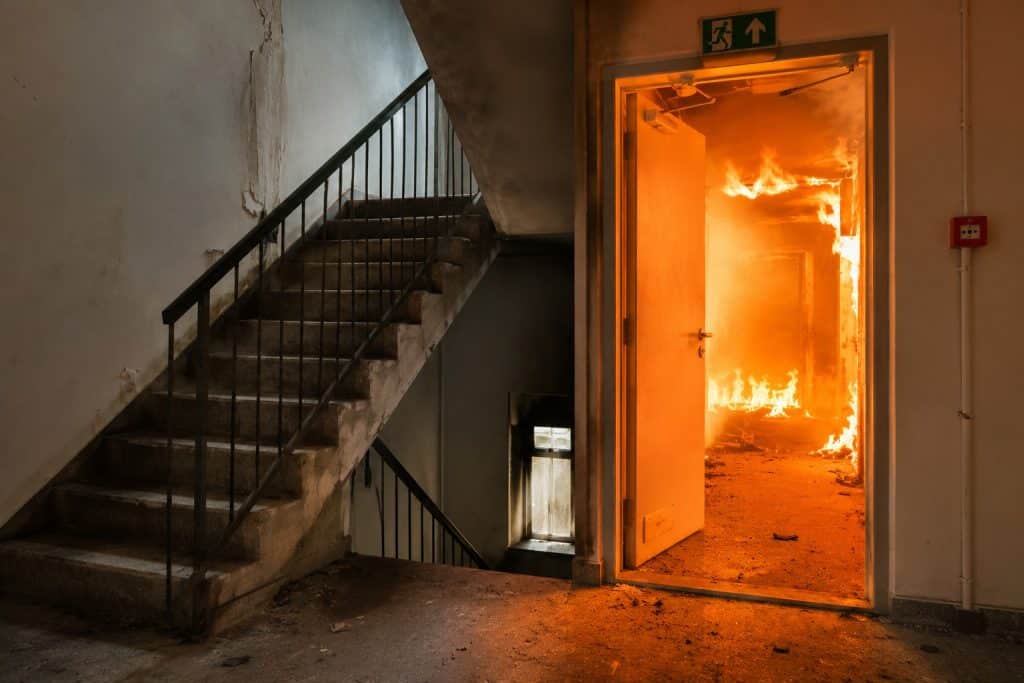
When people think about fire safety in buildings, they often assume the goal is to stop a fire from happening altogether. While prevention is important, building designers and fire engineers also plan for another possibility: that a fire may occur despite every precaution.
Modern buildings are therefore designed with the expectation that fire is possible. Rather than assuming every fire can be prevented, they are engineered to fail safely, slowing the spread of fire, protecting the structure for as long as possible, and giving occupants the time they need to escape.
This philosophy is at the heart of modern building regulations and passive fire protection. A well-designed building doesn’t have to remain undamaged after a fire, but it should continue to perform in a way that protects lives while emergency services respond.
Accepting That Fires Can Happen
No building is completely immune to fire.
Electrical faults, cooking accidents, faulty appliances, or deliberate acts can all lead to fires, even in well-managed buildings. Because of this, fire safety is based on reducing risk and limiting the consequences rather than relying on prevention alone.
Modern buildings are designed to cope with fire in a controlled way. Instead of allowing flames and smoke to spread rapidly throughout the structure, a range of protective measures work together to contain the incident and reduce its impact.
The aim is simple: keep the building stable long enough for people to leave safely and for firefighters to begin tackling the fire.
Structural Stability Is a Priority
One of the most important objectives during a fire is preventing premature structural collapse.
As temperatures rise, many construction materials begin to lose strength. Steel, for example, does not burn, but it softens significantly when exposed to extreme heat. Timber gradually chars, reducing the size of its structural section, while concrete can crack or spall if subjected to prolonged high temperatures.
To address these risks, structural elements are often protected with fire-resistant materials that delay the effects of heat. Beams, columns, floors, and load-bearing walls are designed to achieve specific fire resistance ratings, helping them maintain their integrity for a defined period.
This doesn’t mean the building is expected to survive indefinitely. Instead, it is designed to remain stable for long enough to support evacuation and emergency response.
Containing Fire Instead of Chasing It
Modern fire safety focuses heavily on compartmentation.
A building is divided into smaller fire-resistant sections using walls, floors, ceilings, fire doors, and other passive fire protection measures. If a fire starts in one compartment, these barriers help prevent it from spreading immediately into neighbouring areas.
By restricting the movement of flames, heat, and smoke, compartmentation limits the size of the fire and reduces the number of people exposed to danger.
This approach also gives firefighters a much better opportunity to control the incident before it affects the entire building.
Controlling Smoke Is Just as Important
Smoke is often responsible for more injuries and fatalities than flames themselves.
For this reason, buildings are designed not only to resist fire but also to slow the movement of smoke. Fire doors fitted with smoke seals, protected escape routes, smoke control systems, and carefully planned compartmentation all help keep evacuation routes usable for longer.
Even where a fire cannot be extinguished immediately, slowing the spread of smoke can make a significant difference to the safety of occupants.
A building that successfully limits smoke movement is often considered to have performed exactly as intended.
Every Minute Matters
Many fire protection products are given ratings such as 30, 60, or 120 minutes.
These ratings are sometimes misunderstood as representing the total lifespan of a building during a fire. In reality, they indicate how long a particular component has demonstrated its ability to perform under standard fire test conditions.
Those additional minutes are invaluable.
They provide time for occupants to recognise the danger, begin evacuating, assist vulnerable people, and allow firefighters to arrive before the fire grows beyond control.
Modern buildings are carefully designed so that these individual fire-resistant elements work together to maximise the amount of safe evacuation time available.
Passive Fire Protection Works Continuously
Unlike active fire protection systems that rely on activation, passive fire protection is always in place.
Fire-resistant walls, fire doors, cavity barriers, fire stopping products, structural protection, and smoke seals quietly perform their role every day without requiring power or human intervention.
During normal building use, these systems are almost invisible.
However, when a fire occurs, they immediately begin limiting fire spread, protecting escape routes, and helping the building continue performing safely under extreme conditions.
This is why passive fire protection is often described as the backbone of a building’s fire safety strategy.
Buildings Are Designed as Complete Systems
No single product can make a building fire safe on its own.
Instead, modern buildings rely on multiple layers of protection working together. Detection systems provide early warning, emergency lighting assists evacuation, fire doors contain fire and smoke, compartment walls limit spread, and structural fire protection helps prevent collapse.
Each system supports the others.
If one layer were missing or compromised, the overall performance of the building during a fire could be significantly reduced.
Fire safety is therefore achieved through careful planning, design, installation, and ongoing maintenance rather than any individual product.
Maintenance Keeps Buildings Performing as Intended
Even the best-designed building can lose its fire performance if protective measures are neglected.
Damaged fire doors, missing cavity barriers, poorly sealed service penetrations, or alterations carried out without considering compartmentation can all reduce a building’s ability to perform safely during a fire.
Regular inspections and maintenance ensure that the original fire safety design continues to function throughout the life of the building.
Fire protection should never be viewed as something that only matters during construction. It requires ongoing attention to remain effective.
Safe Failure Is Good Engineering
The phrase “designed to fail safely” may sound alarming, but it reflects good engineering rather than weakness.
Engineers understand that under extreme conditions, every material and every structure has limits. Rather than pretending those limits do not exist, modern design ensures that when components eventually reach them, they do so in a predictable and controlled way.
This controlled performance protects occupants, supports evacuation, and provides firefighters with the safest possible conditions in which to work.
It is not about making a building indestructible; it is about making it behave safely when subjected to extraordinary circumstances.
Final Thoughts
Modern buildings are not designed on the assumption that fires will never happen. Instead, they are designed to respond to fire in a controlled and predictable way.
Through structural fire protection, compartmentation, fire doors, cavity barriers, smoke control, and other passive fire protection measures, buildings are engineered to slow the spread of fire, protect their structural integrity, and give occupants the valuable time they need to escape safely.
The success of a building during a fire is not measured by whether it remains untouched, but by how effectively it protects the people inside. In many cases, the systems that make this possible are hidden behind walls, above ceilings, and inside roof spaces, working quietly until the moment they are needed most.
For expert advice on fire protection and prevention measures, contact Martyn Young Fireproofing Consultancy on 07585 896648