

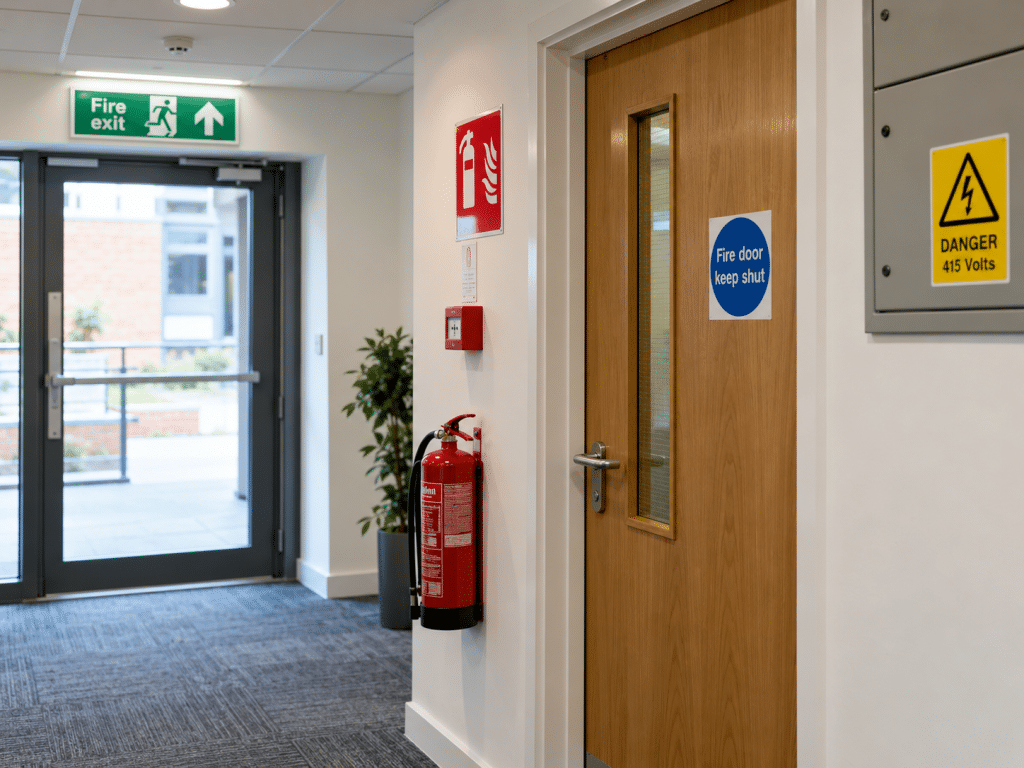
Walk through almost any workplace, school, hospital, warehouse, or public building, and you’ll notice a variety of fire safety signs displayed on walls, doors, and equipment. Some are red, some are green, others are blue or yellow. While these colours may seem like a simple design choice, they actually serve a very important purpose.
Fire safety signs are colour-coded to communicate information quickly and clearly, particularly during emergencies when every second counts. In a stressful situation, people need to be able to recognise instructions and safety information instantly without having to stop and read lengthy text.
Understanding what the different colours mean can help improve awareness of fire safety and make it easier to respond appropriately during an emergency.
Why Colour Coding Is Important
During a fire or other emergency, visibility may be reduced, people may be under stress, and quick decisions often need to be made. Colour coding provides an immediate visual cue that helps people understand the purpose of a sign before they even read the wording.
A consistent system also means that people can recognise safety information in different buildings, workplaces, and public spaces without needing to learn a new set of rules every time they enter a new environment.
The colours used on safety signs are generally standardised to ensure they communicate the same message wherever they are installed.
Red Signs – Fire Equipment and Emergency Action
Red is the colour most people associate with fire safety, and for good reason.
Red signs are commonly used to identify fire-fighting equipment such as:
- fire extinguishers,
- fire blankets,
- hose reels,
- and fire alarm call points.
The bright colour helps these items stand out so they can be located quickly in an emergency.
Red is also often used on signs that indicate emergency actions relating to fire protection systems. Because red naturally attracts attention, it is ideal for highlighting equipment that may need to be used during a fire.
Green Signs – Safe Conditions and Escape Routes
Green signs are generally used to indicate safety information and safe routes.
These signs commonly identify:
- fire exits,
- emergency escape routes,
- assembly points,
- first aid stations,
- and emergency exits.
During an evacuation, green signs help direct occupants towards safety. They are designed to provide reassurance and guidance rather than warnings.
The familiar running figure and directional arrows found on fire exit signs are among the most recognisable examples of green safety signage.
Blue Signs – Mandatory Actions
Blue signs are used to communicate instructions that must be followed.
In fire safety environments, blue signs may indicate:
- fire doors that must be kept shut,
- areas where specific safety procedures apply,
- or instructions relating to building safety measures.
A common example is the familiar “Fire Door Keep Shut” sign found on fire doors throughout many buildings.
These signs are not warning of a danger directly but are instead providing instructions that help maintain overall fire safety.
Yellow Signs – Warnings and Hazards
Yellow signs are used to highlight potential hazards and draw attention to risks that may require caution.
Although they are not exclusively used for fire safety, yellow signs often appear in areas where there may be:
- electrical hazards,
- flammable substances,
- hot surfaces,
- or other dangers that could contribute to a fire risk.
The purpose of these signs is to alert people to hazards before an incident occurs, helping to prevent accidents and improve overall safety.
Why Consistency Matters
Imagine entering a building during an emergency and finding that every sign used different colours without any clear meaning. People would need to stop and interpret the information, losing valuable time.
The standardised colour system helps ensure that safety information can be understood immediately, even by people who have never visited the building before.
This consistency is particularly important in public buildings, workplaces, hospitals, schools, and other environments where large numbers of people may need to evacuate quickly.
Fire Safety Signs Work Together
Individual signs are useful, but their real value comes from how they work together as part of a wider safety strategy.
For example, during an evacuation:
- green signs guide people towards exits,
- blue signs reinforce important fire door instructions,
- red signs identify fire-fighting equipment,
- and yellow signs highlight hazards that should be avoided.
Together, they create a system that helps occupants navigate the building safely and respond appropriately to different situations.
More Than Just Compliance
Many people assume fire safety signs exist simply to satisfy regulations, but their purpose goes far beyond compliance.
Effective signage improves awareness, supports safe behaviour, and helps people make quicker decisions during emergencies. Even when a building’s occupants are unfamiliar with the layout, clearly positioned signs can help guide them towards safety.
In many cases, the information provided by fire safety signs may only be needed during a rare emergency, but when that moment arrives, their importance becomes clear.
Who Is Responsible for Fire Safety Signage?
In many workplaces, commercial buildings, apartment blocks, and public premises, fire safety signage is not simply a recommendation; it is a legal requirement. Fire exit signs, fire door notices, fire alarm call point signs, fire-fighting equipment signs, and assembly point signs all play an important role in helping occupants understand what actions to take during an emergency.
The responsibility for ensuring fire safety signage is correctly installed and maintained typically falls to the building owner, employer, landlord, facilities manager, or other designated “Responsible Person” under fire safety legislation. This includes making sure signs remain clearly visible, undamaged, up to date, and positioned where they can be easily seen when needed.
Over time, signs can become faded, obscured by furniture or decorations, damaged during building works, or removed altogether. Regular fire safety inspections should include checks of all signage to ensure it continues to provide clear guidance and complies with current fire safety requirements. After all, even the most effective evacuation plan is far less useful if people cannot quickly identify escape routes or fire safety equipment during an emergency.
Final Thoughts
The different colours used on fire safety signs are not random. Each colour has a specific meaning designed to communicate important information quickly and effectively.
Red signs identify fire-fighting equipment, green signs guide people to safety, blue signs provide mandatory instructions, and yellow signs warn of potential hazards. Together, they form a simple but highly effective visual language that helps improve safety in buildings of all types.
Although they are often overlooked during everyday life, fire safety signs play a vital role during emergencies. Their colour-coded design allows people to recognise critical information at a glance, helping to protect lives when every second matters.