

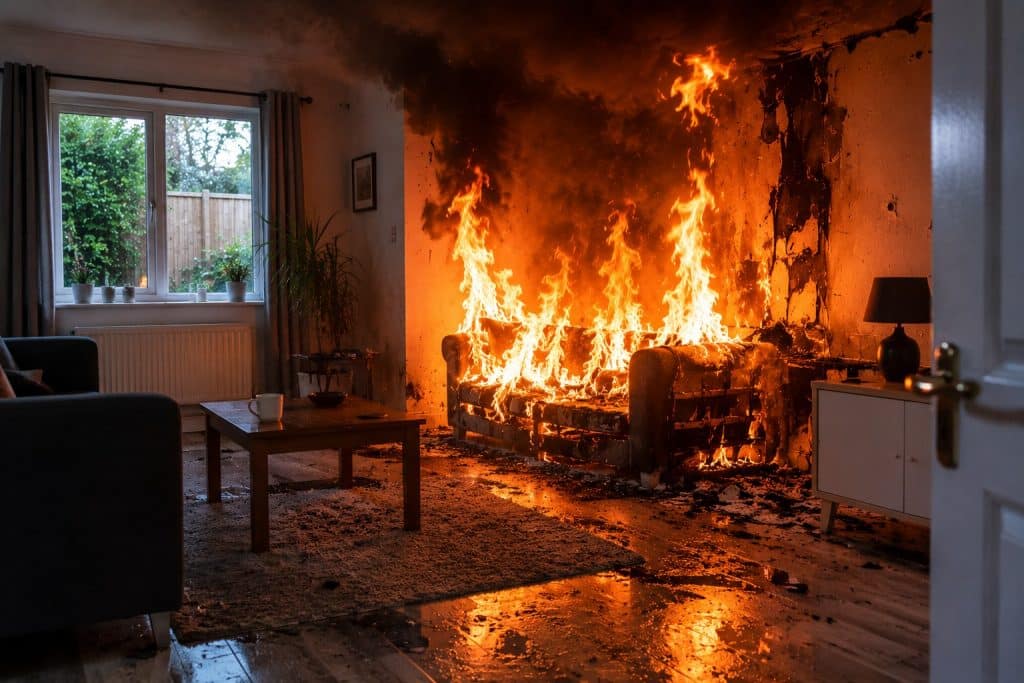
When a major fire makes the news, one question often comes up afterwards: why did one building suffer extensive damage while another remained largely intact?
At first glance, it may seem like luck plays a major role. However, the reality is that a building’s ability to withstand a fire is often determined long before the fire ever starts. Factors such as design, construction methods, building materials, and fire protection systems can all have a significant impact on how a building performs during an emergency.
While no building is completely immune to fire, some are designed to contain and resist it far more effectively than others. Understanding why can provide valuable insight into the role that modern fire safety measures play in protecting lives and property.
Fire Is Not the Same in Every Building
Fires behave differently depending on the environment in which they occur.
The size of rooms, the layout of the building, the materials used during construction, and even the contents inside can all influence how a fire develops. A fire in a small compartmentalised building may remain contained for a significant period, while the same fire in a more open environment could spread rapidly.
This is why fire safety professionals focus not only on preventing fires from starting, but also on controlling how they behave if one occurs.
The way a building responds to fire is often just as important as the fire itself.
Building Design Plays a Major Role
One of the biggest factors influencing fire performance is the overall design of the building.
Modern buildings are generally designed with fire safety in mind from the earliest planning stages. Escape routes, fire-resistant walls, protected stairwells, and compartmentation systems are all incorporated to help manage the spread of fire and smoke.
The goal is often not to stop a fire entirely, but to slow it down and keep it contained within a specific area. This allows occupants more time to evacuate and emergency services more time to respond.
Buildings that lack these features or have compromised fire protection systems are often much more vulnerable to rapid fire spread.
The Importance of Fire Compartmentation
One of the most effective ways a building survives a fire is through compartmentation.
Compartmentation involves dividing a building into separate fire-resistant sections using walls, floors, ceilings, and fire doors. These compartments are designed to prevent fire and smoke from spreading freely throughout the structure.
If a fire starts in one room, compartmentation helps keep it there for a specified period of time. This can dramatically reduce damage and protect critical escape routes.
Without compartmentation, a fire may spread quickly through corridors, staircases, ceiling voids, and adjoining rooms, making containment far more difficult.
Many of the buildings that perform well during fires do so because their compartmentation systems remain intact.
Smoke Control Is Just as Important as Fire Resistance
When people think about fire damage, they often focus on flames. However, smoke is often responsible for a significant portion of the danger and destruction.
Smoke spreads rapidly through buildings, reducing visibility and carrying toxic gases into areas that may not yet be affected by fire. Effective buildings incorporate measures to control smoke movement and protect escape routes.
Features such as smoke seals, fire doors, fire-stopping systems, and protected stairwells all help limit smoke spread. In larger buildings, specialist smoke control systems may also be used to manage airflow and maintain safer evacuation routes.
A building that effectively controls smoke often performs significantly better during a fire than one that does not.
The Materials Used Matter
The materials used to construct a building can have a major impact on how it responds to fire.
Some materials naturally resist fire better than others. Concrete, masonry, and certain fire-resistant boards can withstand high temperatures for extended periods without significant loss of strength.
Other materials may ignite more easily or contribute to fire growth if not properly protected.
This does not necessarily mean one material is always better than another. For example, timber can perform very well when properly protected, while steel, which is non-combustible, can lose strength rapidly when exposed to extreme heat.
What matters most is how materials are used and protected within the overall fire safety strategy.
Structural Protection Makes a Difference
A building’s structural elements must remain stable for as long as possible during a fire.
If beams, columns, or floors lose their ability to support loads, partial or complete collapse can occur. This not only increases damage but also creates significant risks for occupants and firefighters.
To address this, many buildings incorporate structural fire protection measures such as:
- intumescent coatings,
- fire-resistant boards,
- fireproofing sprays,
- and other passive fire protection systems.
These measures help protect key structural components from heat, allowing the building to maintain its integrity for longer.
Small Details Can Have a Big Impact
One of the most overlooked aspects of fire safety is the role of seemingly minor details.
A building may have fire-resistant walls and floors, but if gaps around cables, pipes, or ducts are left unsealed, fire and smoke can bypass these barriers surprisingly easily.
This is why fire stopping is such an important part of passive fire protection. Products such as fire-rated sealants, fireproof foams, collars, wraps, and cavity barriers help ensure that fire-resistant compartments remain effective.
In many cases, the performance of an entire building can be affected by a handful of small openings that were not properly protected.
Fire Protection Is About Buying Time
One of the biggest misconceptions about fire safety is that fire protection systems are designed to make buildings fireproof.
In reality, most fire protection measures are intended to provide time.
Time for occupants to recognise the danger.
Time for evacuation.
Time for emergency services to arrive.
Time for firefighters to control the incident before it spreads further.
The buildings that survive fires most successfully are often the ones that can maintain this valuable time advantage through effective design and fire protection systems.
Why Modern Fire Safety Standards Matter
Building regulations and fire safety standards continue to evolve as new research improves our understanding of fire behaviour.
Modern buildings are generally subject to stricter requirements regarding compartmentation, structural protection, fire stopping, smoke control, and means of escape. These requirements help improve overall resilience and reduce the likelihood of widespread fire damage.
While older buildings can also achieve excellent fire performance, maintaining and upgrading fire protection measures is often essential to ensure they continue meeting modern expectations.
Final Thoughts
Some buildings survive fires better than others because they are designed and protected to manage fire rather than simply endure it.
Factors such as compartmentation, smoke control, structural protection, fire-resistant materials, and passive fire protection systems all work together to slow the spread of fire and protect the building’s integrity.
Often, the most effective fire safety measures are the ones people never see. Hidden behind walls, above ceilings, and around service penetrations, these systems quietly help contain fire and buy valuable time when it matters most.
When a building performs well during a fire, it is rarely by accident. More often, it is the result of careful planning, good design, and the effective use of fire protection measures working together behind the scenes.
For expert advice on fire protection and prevention measures, contact Martyn Young Fireproofing Consultancy on 07585 896648