

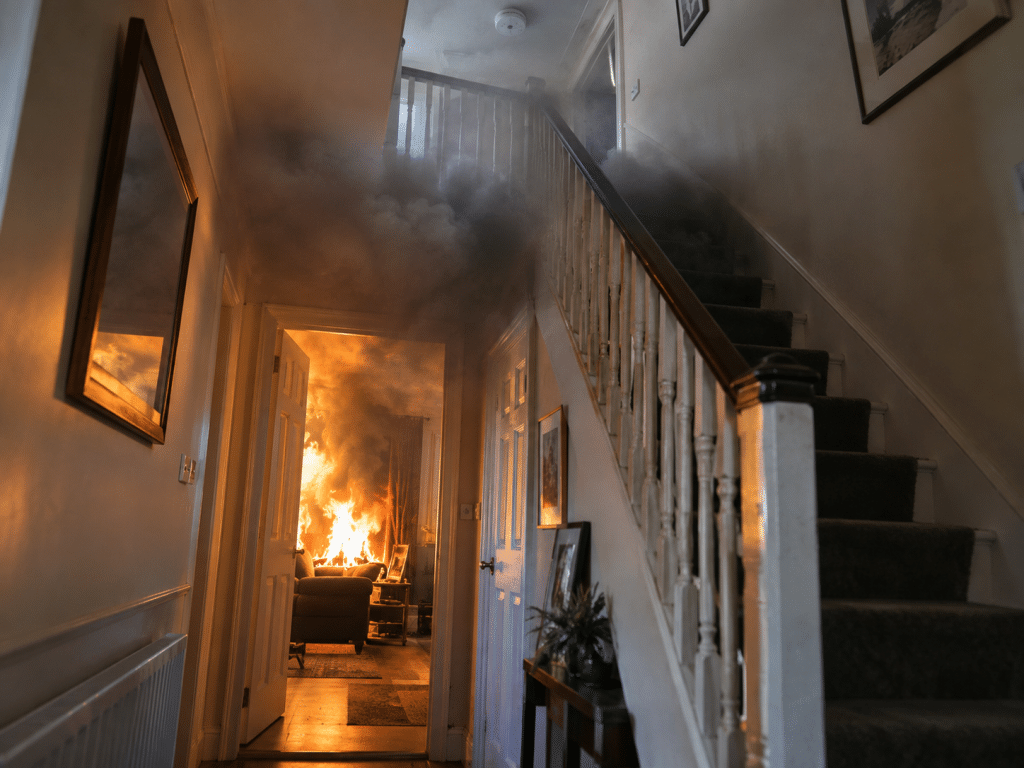
One of the most important things to understand about fire is that it naturally moves upwards. This behaviour affects how fires spread through buildings, how smoke travels, and how fire safety systems are designed to protect people and property.
Although it may seem like a simple observation, the upward movement of fire has major implications for building safety. It influences everything from the placement of smoke alarms to the design of escape routes and passive fire protection systems.
Understanding why fire spreads upwards can help explain how fires develop so quickly, and why certain fire safety measures are so important.
Why Fire Moves Upwards
Fire spreads upwards primarily because of heat and hot gases.
When a fire burns, it heats the surrounding air. Hot air becomes less dense than cooler air, causing it to rise naturally. As the hot gases rise, they carry flames, smoke, and heat upward with them.
This process creates a continuous movement known as convection. As the hot air rises, cooler air is pulled in underneath to replace it, feeding the fire with fresh oxygen. This cycle allows the fire to continue growing and spreading vertically.
Because of this natural airflow, fire will almost always travel upwards before spreading sideways or downwards.
Smoke Rises Before Flames
In many fires, smoke spreads upward even faster than the flames themselves.
Hot smoke and gases collect near ceilings and in upper areas of a building very early in a fire. This is why smoke alarms are typically installed on ceilings, because that is where smoke reaches first.
As smoke builds, it can quickly spread through hallways, stairwells, loft spaces, and upper floors, often before people are aware of the fire below.
This is also why upper levels of buildings can become dangerous surprisingly quickly during a fire, even if the fire started elsewhere.
How Fire Spreads Through Homes
In houses and flats, fire often spreads upward through staircases, ceiling voids, wall cavities, and loft spaces.
For example, a fire that begins in a ground-floor living room may eventually break through the ceiling into the floor above. Once it reaches the loft or roof space, the fire can spread rapidly across the building.
Open staircases can also act like chimneys, allowing heat and smoke to move quickly between floors. This is one reason why keeping internal doors closed can help slow the spread of fire and smoke.
The upward movement of heat means that upper floors may become heavily smoke-logged long before flames actually reach them.
Why Fire Compartmentation Matters
Because fire naturally travels upwards, buildings are designed with features intended to slow this movement.
Fire compartmentation is one of the most important examples. Walls, floors, ceilings, and fire doors are designed to contain fire within a specific area for a set period of time.
Ceilings between floors play a particularly important role because they help stop fire from immediately spreading upward into the next level. If these barriers are compromised, for example, by unsealed gaps around pipes or cables, the fire can spread much more easily.
This is why proper fire stopping around service penetrations is so important in both residential and commercial buildings.
Hidden Pathways for Upward Fire Spread
Fires do not only spread through open spaces. Heat, smoke, and flames can also move through hidden routes within a building.
Wall cavities, ductwork, ceiling voids, and gaps around services can all allow fire to travel upward behind the scenes. These hidden pathways are particularly dangerous because the fire may spread unnoticed for some time before becoming visible.
This is one reason why passive fire protection systems such as cavity barriers, fire stopping, and intumescent products are so important in modern construction.
The Importance of Escape Routes
Understanding how fire spreads upward is critical when designing safe escape routes.
In many buildings, stairways are the primary means of escape. However, because heat and smoke rise naturally, staircases can quickly fill with smoke if not properly protected.
Fire doors, smoke seals, and compartmentation systems help protect these routes long enough for occupants to evacuate safely. In larger buildings, stairwells may also be specially ventilated or enclosed to limit smoke spread.
The upward movement of fire is one of the key reasons why protected escape routes are such an important part of building design.
Why Smoke Alarms Are Installed on Ceilings
The upward movement of smoke also explains why smoke alarms are usually mounted on ceilings rather than walls.
Because smoke rises and accumulates at the highest point in a room, ceiling-mounted alarms can detect smoke earlier than alarms placed lower down. Early detection is critical because fires can develop rapidly once smoke begins to spread.
Correct alarm placement is therefore based directly on the way fire and smoke naturally behave.
Fire Safety in Multi-Storey Buildings
The risks associated with upward fire spread become even more important in taller buildings.
In multi-storey properties, fires can spread vertically through shafts, stairwells, service risers, and external cladding systems if adequate protection is not in place.
This is why high-rise buildings rely heavily on compartmentation, fire-resistant materials, and carefully designed evacuation strategies to control the movement of fire and smoke.
Preventing vertical fire spread is one of the biggest challenges in modern building fire safety.
Final Thoughts
Fire always spreads upwards because hot air, smoke, and gases naturally rise. While this may seem like a basic principle, it has a major impact on how fires develop and how buildings are designed to protect against them.
From smoke alarm placement to fire compartmentation and protected escape routes, many fire safety measures exist specifically because of the way fire behaves inside buildings.
Understanding this upward movement helps explain why fire can spread so quickly, and why slowing that spread is such a critical part of protecting lives and property.
In fire safety, understanding how fire behaves is often the first step toward controlling it.
For expert advice on fire protection and prevention measures, contact Martyn Young Fireproofing Consultancy on 07585 896648.