

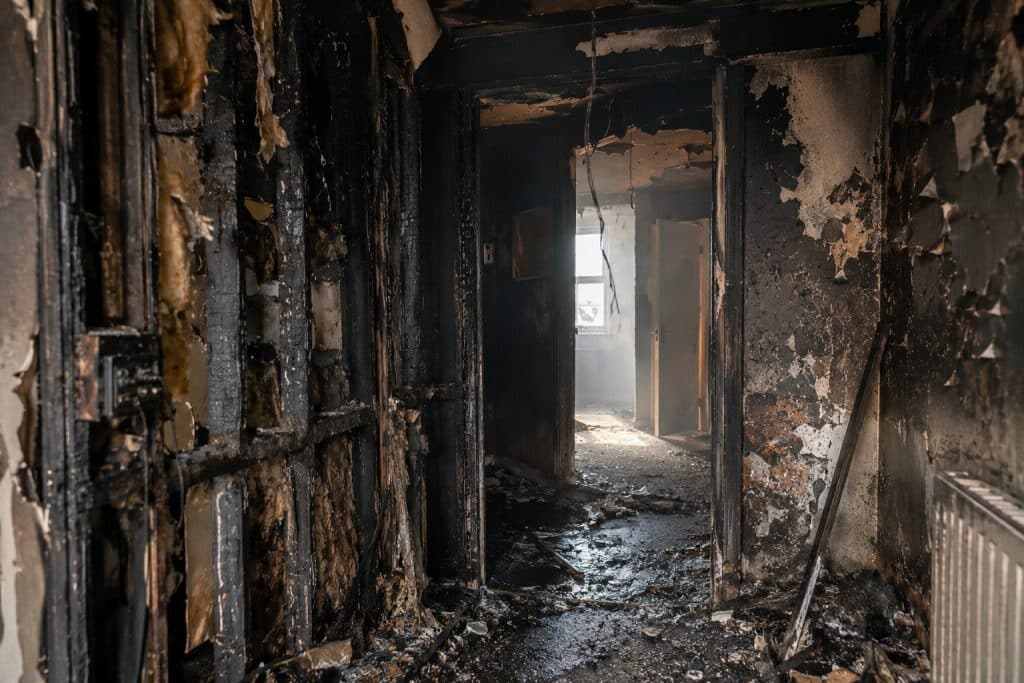
Most people are familiar with visible fire safety measures such as smoke alarms, fire extinguishers, and sprinkler systems. These systems play an important role in detecting and responding to fires, but there is another layer of protection that often goes unnoticed: passive fire protection.
Passive fire protection is built into the structure of a building. It works continuously, without electricity, sensors, or human intervention, helping to slow the spread of fire and smoke when an emergency occurs.
But what would happen if buildings had no passive fire protection at all?
The answer is simple: fires would spread faster, buildings would suffer significantly more damage, escape routes would become compromised much sooner, and the risks to occupants and firefighters would increase dramatically.
What Is Passive Fire Protection?
Passive fire protection refers to the fire-resistant elements built into a structure to help contain fire and smoke.
Examples include:
- fire-resistant walls and floors,
- fire doors,
- cavity barriers,
- fire stopping around pipes and cables,
- smoke seals,
- intumescent products,
- and structural fire protection systems.
Unlike active systems, passive fire protection does not need to be switched on or activated. It is always present, quietly working in the background to limit fire spread and protect the building.
Without these measures, fires would behave very differently.
Smoke Would Spread Through Buildings Much Faster
One of the first consequences of removing passive fire protection would be the rapid spread of smoke.
During a fire, smoke naturally seeks out any available route through a building. Small gaps around pipes, cables, ducts, doors, and wall penetrations can all become pathways for smoke to travel.
Normally, fire stopping systems and smoke seals help restrict this movement. Without them, smoke could quickly fill corridors, stairwells, neighbouring rooms, and upper floors.
This would make escape far more difficult, particularly because smoke often reaches occupants long before the flames themselves.
In many cases, buildings would become unsafe to occupy within a much shorter period of time.
Fire Would Spread Beyond the Room of Origin
One of the primary goals of passive fire protection is compartmentation.
Buildings are divided into separate fire-resistant sections designed to contain a fire within a specific area. Fire-resistant walls, ceilings, floors, and doors all work together to achieve this.
Without compartmentation, a fire that starts in a single room could spread freely throughout the building.
Instead of being contained within one area, flames could move through corridors, ceiling voids, wall cavities, and adjoining rooms with very little resistance.
A small fire could quickly become a building-wide incident.
Escape Routes Would Be Compromised Earlier
Escape routes are among the most important areas protected by passive fire protection systems.
Corridors, stairwells, and exits are often separated from higher-risk areas using fire-resistant construction and fire doors. These measures help keep evacuation routes usable for as long as possible.
Without passive fire protection, smoke and heat could reach these routes much sooner.
Occupants would have less time to evacuate, and the chances of becoming trapped inside the building would increase significantly.
The difference between a protected and unprotected escape route can often be measured in minutes, but those minutes can save lives.
Structural Damage Would Occur More Quickly
Many people assume that a building’s structure will naturally withstand a fire, but this is not always the case.
Extreme heat can weaken structural components over time. Steel may lose strength, timber can become compromised, and certain construction materials may deteriorate under prolonged exposure to fire.
Passive fire protection helps shield structural elements from heat, allowing them to maintain their integrity for longer.
Without this protection, structural failure could occur much sooner, increasing the risk of collapse and making firefighting operations far more dangerous.
Hidden Spaces Would Become Fire Highways
Modern buildings contain numerous hidden spaces behind walls, above ceilings, and beneath floors.
These cavities often house electrical cables, pipework, ventilation systems, and other services. Without cavity barriers and fire stopping systems, these concealed spaces can allow fire to spread rapidly through the building.
Fire could travel behind walls and above ceilings long before occupants are aware of the danger.
By the time visible flames appear elsewhere, the fire may already have spread extensively throughout the structure.
This hidden fire spread is one of the reasons passive fire protection is such an essential part of modern construction.
Firefighting Would Become More Difficult
Passive fire protection does not just benefit building occupants; it also helps firefighters.
When fire is contained within a compartment, emergency services can focus their efforts on a smaller area. This improves visibility, reduces fire growth, and helps limit overall damage.
Without compartmentation and fire stopping, firefighters would be dealing with larger, faster-moving fires that spread unpredictably throughout the building.
The risk to emergency responders would increase, and extinguishing the fire would become considerably more challenging.
Modern Buildings Would Be Far Less Resilient
Many of the fire safety standards we take for granted today exist because of lessons learned from previous fires.
Modern building regulations require passive fire protection measures because they have repeatedly proven their value in real-world incidents. Buildings that successfully contain fires often do so because these systems perform exactly as intended.
Without passive fire protection, even relatively small fires could lead to widespread damage, prolonged business interruption, and costly rebuilding work.
The overall resilience of buildings would be dramatically reduced.
Fire Safety Is Really About Time
One of the most important concepts in fire safety is time.
Passive fire protection is not necessarily designed to stop a fire completely. Instead, it is designed to slow the spread of fire and smoke, giving people time to escape and emergency services time to respond.
Without passive fire protection, that valuable time would disappear much more quickly.
A fire that might otherwise remain contained for an hour could spread through multiple areas of a building in a fraction of that time.
The consequences for occupants, property, and firefighters could be severe.
Final Thoughts
It is easy to overlook passive fire protection because most of it remains hidden behind walls, ceilings, floors, and doors. Yet these unseen systems play a critical role in how buildings perform during a fire.
Without fire compartmentation, fire stopping, cavity barriers, smoke seals, and structural protection systems, fires would spread faster, smoke would travel further, and buildings would become unsafe much more quickly.
While active systems such as alarms and extinguishers are essential, they work best when supported by effective passive fire protection. Together, they form a layered fire safety strategy that protects lives, limits damage, and helps buildings withstand the challenges of a fire.
In many ways, passive fire protection is the reason modern buildings are able to survive fires as well as they do. Without it, the outcome of many fires would be very different indeed.
For expert advice on fire protection and prevention measures, contact Martyn Young Fireproffing Consultancy on 07585 896648