

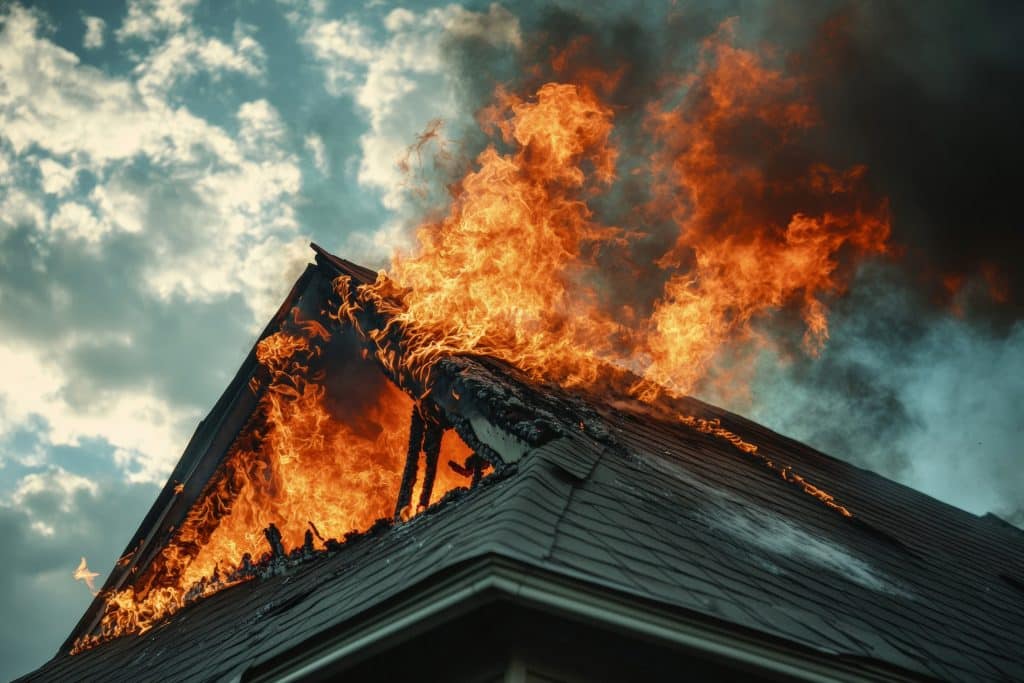
In many buildings, a fire doesn’t stay where it starts. One of the most common and overlooked ways it spreads is through the loft space, where open areas and hidden services can allow fire and smoke to travel rapidly across a property.
Because lofts sit above living areas and often connect multiple rooms, they can act as a pathway for fire to move between different parts of a building. This means a small fire in one room can quickly escalate into a much larger incident if it reaches the loft.
Understanding how fire behaves in these spaces, and what can be done to slow it down, is essential for improving overall fire safety.
Why Loft Spaces Allow Fire to Spread So Easily
Lofts are rarely designed with fire safety as a primary concern, especially in older buildings. Unlike internal walls and floors, which are often built to resist fire for a specific period, loft spaces are typically more open and less compartmentalised.
This creates an environment where fire can spread quickly once it enters the roof space. Heat rises naturally, so a fire in a room below will often move upwards, eventually breaking through ceilings or weak points. Once inside the loft, flames and hot gases can travel laterally across the space, affecting multiple areas of the building at once.
Because lofts are often out of sight, a fire can develop here without being immediately noticed, increasing the risk of significant damage before action can be taken.
The Role of Smoke and Hot Gases
While flames are a concern, smoke and hot gases are often the main drivers of fire spread in loft spaces. These gases can move rapidly through even the smallest openings, filling the loft before flames fully develop.
Once inside, smoke can travel across the entire roof space and begin to filter back down into other parts of the building. This not only spreads the fire but also makes escape more dangerous by affecting multiple rooms and escape routes.
Because smoke rises and accumulates at the highest point, loft spaces often become heavily smoke-filled early in a fire, which can accelerate the spread of heat and increase pressure on structural elements.
How Services Create Hidden Fire Pathways
One of the biggest contributors to fire spread in lofts is the presence of services such as electrical cables, pipes, and ventilation systems. These services often pass through ceilings and walls, creating small openings that can compromise fire-resistant barriers.
If these gaps are not properly sealed, they can act as hidden pathways for fire and smoke. What might seem like a minor opening around a cable or pipe can allow heat and gases to move quickly between floors and into the loft.
Over time, additional installations or modifications can create even more of these pathways, increasing the overall risk if they are not properly managed.
How to Slow Fire Spread Through the Loft
The key to improving loft fire safety is not to eliminate fire entirely, but to slow its movement. This gives occupants more time to escape and helps prevent a small fire from becoming a building-wide incident.
One of the most effective steps is ensuring that ceilings below the loft maintain their fire resistance. This means sealing any gaps where services pass through using appropriate fire-stopping materials. By doing this, the loft becomes less accessible to fire originating from lower floors.
In addition, protecting structural elements within the loft, such as timber beams, with intumescent coatings can help delay the effects of heat. These coatings expand when exposed to high temperatures, forming a protective barrier that slows combustion.
Protecting the Loft Access Point
The loft hatch is another important area to consider. If it is poorly fitted or not properly sealed, it can provide a direct route for smoke and fire to pass between the loft and the rooms below.
Improving the fit of the hatch and adding appropriate seals can help maintain the integrity of the ceiling as a fire barrier. In some cases, installing a fire-rated loft hatch may be necessary, particularly in properties where higher levels of protection are required.
Reducing Fire Load in the Loft
The amount of combustible material in a loft also plays a significant role in how a fire develops. Lofts are often used for storage, and items such as cardboard boxes, clothing, and other materials can act as fuel.
Reducing clutter and keeping the space organised can limit how much material is available to burn. This does not prevent a fire from starting, but it can slow its growth and reduce the intensity of the fire if it reaches the loft.
The Importance of Early Detection
Because loft fires can go unnoticed until they become severe, early detection is essential. Smoke alarms installed on the floor below, particularly in hallways and escape routes, can provide early warning if smoke begins to rise into the loft area.
Interlinked alarm systems are especially effective, as they ensure that all occupants are alerted regardless of where the fire starts. This is particularly important in larger properties, where a fire in one area may not be immediately noticeable elsewhere.
Loft Conversions and Fire Safety
In loft conversions, fire safety becomes even more critical because the space is used as part of the living area. In these cases, building regulations typically require additional fire protection measures, including fire-resistant floors, protected escape routes, and upgraded detection systems.
These measures are designed to ensure that occupants can escape safely, even if a fire starts elsewhere in the building.
Final Thoughts
Loft spaces play a much bigger role in fire spread than many people realise. Because they sit above the rest of the building and often contain open areas and hidden services, they can allow fire and smoke to travel quickly if not properly managed.
By understanding how fire behaves in these spaces and taking steps to control its spread, such as sealing gaps, protecting structural elements, and improving detection, you can significantly reduce the risk.
Fire safety is often about slowing things down. In the case of loft spaces, even small improvements can make a meaningful difference, helping to protect both the building and the people inside it when it matters most.
For expert advice on fire protection and prevention measures, contact Martyn Young Fireproofing Consultancy on 07585 896648