

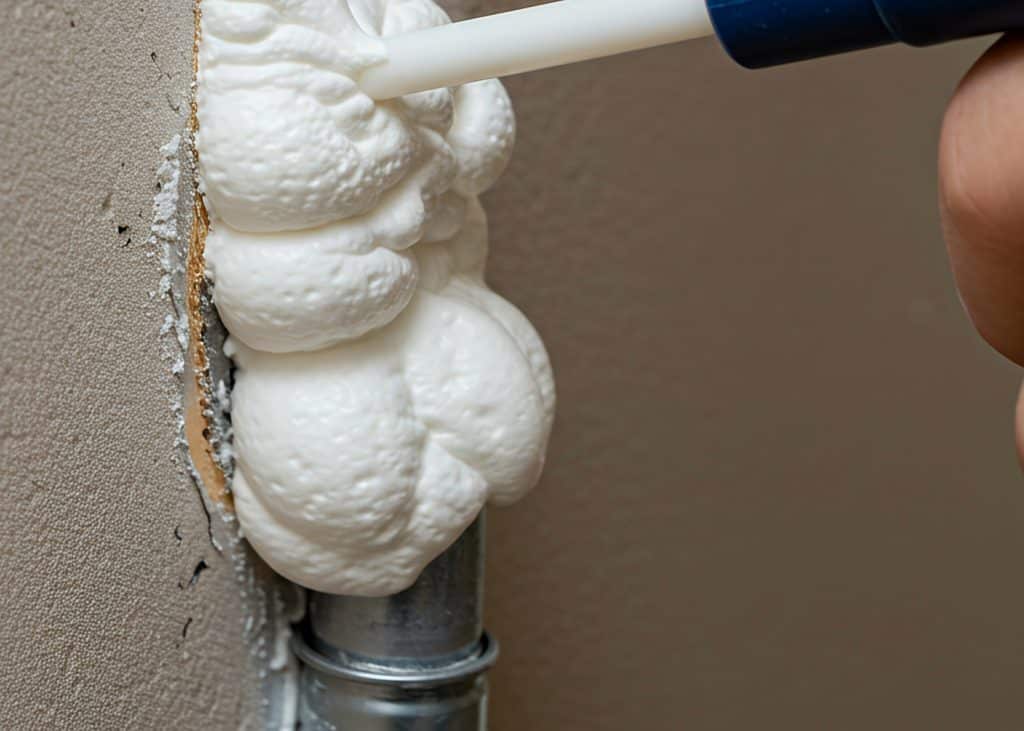
When sealing gaps, service penetrations, or voids in walls and floors, choosing the right firestop product is critical. Two of the most common options are fire-rated expanding foam and intumescent sealant, both designed to prevent fire and smoke from spreading between compartments.
But while they serve a similar purpose, these products are not interchangeable.
So, when should you use fire-rated foam, and when is intumescent sealant the better option?
In this blog, we’ll break down the key differences between the two, explore typical applications, and help you choose the most appropriate firestopping method for your project.
What Is Fire-Rated Foam?
Fire-rated foam is a specially formulated expanding polyurethane (PU) foam that’s been tested for fire resistance. It’s typically sold in aerosol cans and applied via a nozzle, expanding on contact to fill gaps or voids.
Pros:
-
Quick and easy to apply
-
Ideal for filling large or irregular gaps
-
Some foams expand up to 30 times their original volume
-
Can provide up to 4 hours of fire resistance (when tested appropriately)
-
Insulates against sound and temperature as well
Limitations:
-
Can be messy if not carefully applied
-
Requires precise depth and backing for tested fire performance
-
Not always suitable for small joints or linear seals
-
Not designed to be flexible after curing
What Is Intumescent Sealant?
Intumescent sealant is a flexible, non-expanding mastic or caulk that swells up (intumesces) when exposed to high heat. It’s designed for linear joints and around penetrations in fire-rated walls, floors, and ceilings.
Pros:
-
Provides a clean, neat finish for smaller gaps
-
Maintains flexibility once cured (important for movement joints)
-
Reacts to heat by expanding to seal fire and smoke paths
-
Excellent for cable trays, pipe penetrations, and door frames
-
Easy to control and shape with a caulking gun
Limitations:
-
Not suitable for large voids or wide gaps without backing material
-
Application is slower than foam for large areas
-
Fire resistance performance depends heavily on correct joint design
Fire-Rated Foam vs. Intumescent Sealant: Side-by-Side Comparison
| Feature | Fire-Rated Foam | Intumescent Sealant |
|---|---|---|
| Main Use | Filling large voids or service openings | Sealing joints and penetrations |
| Application Method | Aerosol can, nozzle | Cartridge and caulking gun |
| Expansion | Expands to fill space | Does not expand on application |
| Intumescent Reaction | Some foams expand with heat, others don’t | Expands significantly in fire |
| Ideal Gap Size | Larger gaps (10–40mm typical) | Narrow joints (2–25mm typical) |
| Curing Time | Fast curing (approx. 1 hr touch dry) | Slower curing (up to 48 hrs depending) |
| Appearance | Can be messy, usually trimmed or hidden | Neat, paintable finish |
| Fire Rating | Up to 240 minutes (product-specific) | Up to 240 minutes (when installed correctly) |
| Flexibility | Rigid when set | Flexible after curing |
| Compliance Notes | Must be tested for the application type | Must be CE/UKCA marked & tested |
When to Use Fire-Rated Foam
Fire-rated foam is best for:
-
Filling large or irregular-shaped voids
-
Sealing around pipes, cables, ducts or conduits
-
Backfilling service penetrations in masonry walls
-
Areas where speed of application is important
Avoid using foam for:
-
Expansion or movement joints
-
Small or tight linear seals
-
Where a flexible finish is required
Tip: Always check that the fire foam is tested for the specific application (e.g., pipe material, substrate, joint size). Fire performance depends on installation depth and configuration.
When to Use Intumescent Sealant
Intumescent sealant is best for:
-
Linear joints between fire-rated walls, floors, or ceilings
-
Perimeter seals around fire doors or glazed screens
-
Sealing around cable trays or trunking
-
Smaller penetrations where precision is needed
Avoid using sealant for:
-
Large voids without appropriate backing
-
Gaps that exceed the manufacturer’s maximum seal width
Tip: Use a suitable backing rod (e.g., mineral wool) to control seal depth and ensure the fire rating is achieved.
Can You Use Both Together?
Yes, in fact, many firestopping applications require a combination approach.
For example, around a service opening:
-
Fire-rated foam can be used to fill most of the void
-
Intumescent sealant can be applied as a finishing layer for precision sealing and surface finish
This is common in cable tray penetrations or pipe bundles where gaps vary and flexibility at the edge is needed.
Final Thoughts: Which Should You Use?
Choosing between fire-rated foam and intumescent sealant depends on:
-
The size and shape of the gap
-
The required fire resistance rating
-
The type of materials or services involved
-
The movement expected at the joint
-
The tested applications of the product you’re using
For larger or uneven gaps, fire-rated foam offers quick, effective coverage. For neat, compliant joint lines or penetrations needing flexibility, intumescent sealant is the preferred solution.
Whichever product you choose, make sure:
-
It’s tested to EN 1366-4 or equivalent
-
It has clear installation instructions
-
You follow manufacturer-approved configurations to ensure fire protection is not compromised
For expert advice on fire protection and prevention measures, contact Martyn Young Fireproofing Consultancy on 07585 896648